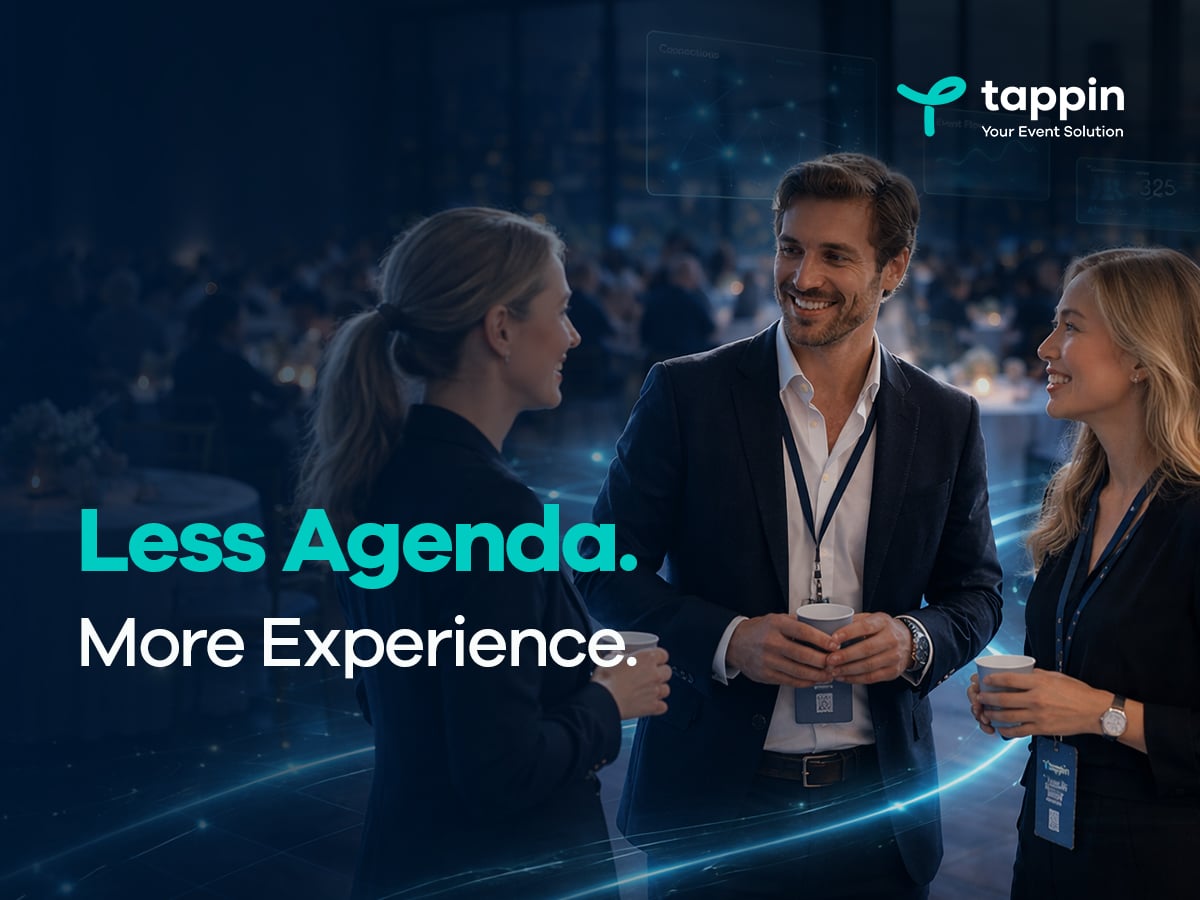
There is a certain comfort in a full agenda. Time slots neatly arranged, sessions planned down to the minute, every break accounted for. But attendee engagement Norway is increasingly challenging that approach. For organizers, it creates a sense of control. For attendees, it signals effort. Yet as expectations continue to rise, that well-structured schedule is starting to reveal a problem: it often leaves no room for the things people actually came for.
The conversation that ran ten minutes over because it was genuinely going somewhere. The connection that was about to happen right before the next session started. The moment to think, to process, to actually absorb what was just said. In filling every available minute, events can end up crowding out the value they were supposed to create.
This is not a fringe observation. It is something that organizers across Norway and the broader Nordic region are increasingly sitting with and beginning to act on. It reflects a broader shift in attendee engagement Norway, where experience is starting to outweigh structure.
Attendee Engagement Norway: The Problem With Packed Programmes
The instinct to fill a programme comes from a reasonable place. Organizers want to deliver value. Attendees are paying with their time. Sponsors want visibility. So more sessions, more speakers, more content that feels like more value. In practice, it often works the other way.
When every hour is scheduled, attendees move through the day in reaction mode. They are processing content without time to reflect on it, meeting people without time to follow up, and navigating from room to room without a moment to decide what actually matters to them. The event delivers a lot. Attendees retain less of it.
There is also something harder to measure at play. Events that feel overstuffed tend to feel impersonal. When every minute is optimized for content delivery, there is no room left for the kind of spontaneous, unscripted moments that often turn out to be the most memorable part of attending something. The hallway conversation. The unplanned introduction. The question that did not fit neatly into the Q&A but got asked anyway, quietly, over coffee.
These are not accidents. They are the experience. And the events that make room for them tend to leave a stronger impression than those that do not.
What Drives Attendee Engagement in Norway
Strong attendee engagement is not a product of volume. It is a product of relevance, connection, and space. Those three things are worth looking at separately. In attendee engagement Norway, this shift toward quality over quantity is becoming increasingly visible.
Relevance
An attendee who is in the right session one that directly relates to a challenge they are currently dealing with is engaged without any effort. An attendee sitting through a session that does not apply to them is not just disengaged; they are mildly resentful for the twenty minutes they will not get back. Relevance is what makes engagement possible. A curated, focused programme with fewer sessions tends to achieve higher relevance per attendee than a broad programme trying to cover everything for everyone.
Connection
Most people attend events, at least in part, because of who else will be there. The content is often a reason to show up. The people are a reason to come back. But genuine connection requires time that is not already spoken for time to have a real conversation rather than an exchange of names and job titles. Events that build in structured networking, open space, or simply longer breaks tend to generate the kind of connections that persist after the event ends. how networking is being reimagined at events.
Space
This is the one that most programmes underestimate. Space between sessions, after a keynote, at the end of the day is not wasted time. It is processing time. It is decision time. It is the window in which an attendee moves from ‘that was interesting’ to ‘here’s what I’m going to do with that.’ Without it, information accumulates and action rarely follows. With it, events start to generate outcomes that outlast the schedule.
Research from the global events industry consistently shows that attendees rank networking and peer connection among the top reasons they choose to attend in person, often above the content programme itself (see insights from Statista)
Why Attendee Engagement Norway Is Shifting in the Nordics
There is something in the Nordic approach to design and experience that maps well onto this shift. The principles that shape everything from furniture to public services in this part of the world simplicity, intentionality, restraint turn out to apply equally well to events.
Norwegian organizers, in particular, tend to have a high sensitivity to whether something is working for the person experiencing it. There is less appetite for events that look impressive from the outside but feel exhausting from the inside. And there is a genuine cultural comfort with doing less, but doing it better with trusting that clarity and focus create more value than density and noise.
That mindset is an asset when it comes to rethinking attendee engagement in Norway. It means the conversation is not starting from scratch. It is catching up with something that many organizers already instinctively understand but have not always had the tools or confidence to act on. It aligns closely with how attendee engagement Norway is evolving today.
Designing for Better Attendee Engagement Norway
Practically, what does a less-is-more approach to programme design look like? It is not simply removing sessions. It is being deliberate about what stays, why it stays, and what replaces what was taken out.
- Fewer, longer sessions with time built in for discussion rather than back-to-back presentations that leave no room for the audience to respond
- Breaks that are long enough to actually be useful not five minutes to refill a coffee, but twenty minutes in which a conversation can genuinely start
- Dedicated networking time that is structured enough to feel intentional but open enough to feel natural
- A programme that covers less ground, but goes deeper so that attendees leave with something they can actually use rather than a broad survey of topics
- Moments of reflection built into the day a short prompt, a facilitated discussion, or simply unscheduled time after a significant session
None of this requires a dramatic overhaul. It often starts with a single decision: what is on this programme that does not need to be? What would the day look like if we removed it?
How Technology Enables This Without Adding Complexity
One reason organizers default to packed programmes is that a lighter structure feels harder to manage. If attendees are not moving through a fixed schedule, how do you keep the day coherent? How do you ensure people know where to go and what is happening? How do you maintain the sense that the event is purposeful rather than loosely organized?
This is where the right technology genuinely helps not by adding complexity, but by removing the operational friction that makes a more fluid programme feel risky. Especially in attendee engagement Norway, where seamless experiences are expected.
When communication, navigation, and networking are all handled inside a single platform, organizers do not need a rigid schedule to hold the event together. Attendees can see what is happening, connect with who they want to meet, receive updates in real time, and move through the day with confidence without the organiser having to script every minute to make that work.
What this looks like with Tappin
Real-time communication keeps attendees informed without requiring a fixed minute-by-minute schedule
Integrated networking tools give structured support to open time so attendees use it well rather than not knowing what to do with it
A single platform for agenda, messaging, and navigation means attendees are never lost or out of the loop, even when the programme is intentionally looser
Post-event follow-up tools extend the connections made during the open parts of the day so the value of less-structured time does not disappear when the event ends
The result, for attendees, is an event that feels well-organized and spacious at the same time. Not chaotic. Not overscheduled. Just right.
Less Agenda Does Not Mean Less Substance
It is worth being direct about the most common concern: that a lighter programme signals less value. That attendees will feel shortchanged if there are fewer sessions, longer breaks, or more open time built into the day.
In practice, the opposite tends to be true. Attendees who have had a genuinely engaging experience one where they made a real connection, had a conversation that changed how they think about something, or left with a clear idea of what to do next do not walk away wishing there had been more sessions. They walk away satisfied. Often more satisfied than they would have been after a day of back-to-back content they barely had time to absorb.
Less agenda means more focus. More relevance. More room for the things that make attending an event worth the effort in the first place. That is not a compromise on substance. It is a better way of delivering it.
The Events That Will Stand Out Are the Ones That Breathe
As events across Norway continue to evolve, the ones that get remembered will not be those that delivered the most content in a day. They will be the ones that made attendees feel like their time was genuinely well spent. That made space for the conversations, the connections, and the moments of insight that cannot be scheduled but can absolutely be designed for.
Attendee engagement Norway does not come from a fuller programme.. It comes from a more intentional one. An agenda that knows what it is for, leaves room for what matters, and trusts that less, done well, is always more.
Tappin was built to support exactly that kind of event giving organizers the tools to run a more fluid, engaging experience without losing coherence, and giving attendees a day that actually stays with them.